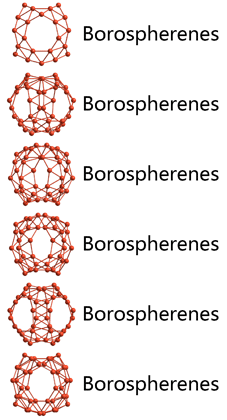
Metal-doped endohedral borospherenes M@B40 have attracted considerable attention since the discovery of the first boroshphenes B40-/0 in 2014. Systematical density functional theory investigations performed herein unveil the ground-state structures and coordination bonding patterns of a series of lanthanide-doped endohedral borospherenes Ln@B400/+, including the doublet C2v Ce@B40+ (1, 2B1), triplet C2v Ce@B40 (2, 3A2), quartet C2v Pr@B40 (3, 4B1), quintet C2v Nd@B40 (4, 5A1), sextet C2 Pm@B40 (5, 6A), septet C2v Sm@B40 (6, 7A2), octet D2d Eu@B40 (7, 8B1), and octet C2v Gd@B40+ (8, 8A2). Detailed principal interaction spin orbital (PISO) and adaptive natural density partitioning (AdNDP) bonding pattern analyses indicate that, with the number of unpaired α-electrons changing from nα = 1, 2, 3, 4, 5, 6, 7, to 7 in the series, their coordination bonding energies decrease monotonically from Ec = 7.22, 6.93, 5.67, 4.85, 4.67, 4.29, 4.02, to 2.07 eV, respectively, with the dominating percentage contributions of the Ln 5d-involved PISOs to the overall Ec increasing almost monotonically from 66 to 83%, while the minor contributions of the Ln 4f-involved PISOs varying between 0.3% and 12.1% and that of Ln 6s-involved PISO pairs remaining basically unchanged in a narrow range between 6% and 8%. In average, the dominating 5d-invloved PISOs in Ln@B40 contribute about 72.8% to the overall Ec, 19.3% higher than that (53.4%) of the 6d-involved PISOs in the newly reported actinide-doped An@B400/+/-, while the minor 4f-involved PISOs in Ln@B40 contribute about 6.1% to Ec, 15.7% lower than that (21.8%) of the 5f-invloved PISOs in An@B400/+/-, quantitatively unveiling the differences in coordination bonding patterns between Ln@B400/+ and An@B400/+/-.