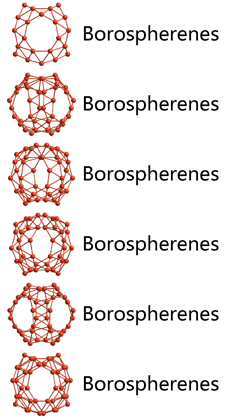
Exploring advanced materials for efficient activation and conversion of CO2 is a crucial approach to mitigate climate change and reduce reliance on fossil fuels. Extensive joint gas-phase mass spectroscopy and kinetic studies performed herein indicate that a mass-selected B6+ monocation can consecutively activate and convert up to seven CO2 to CO under ambient conditions, setting up a record number of CO2 molecules that an isolated cluster can activate in experiments. Detailed theoretical calculations and analyses reveal the ground-state, intermediate, and transition-state geometries as well as CO2-activation and CO-desorption pathways of the concerned species. The catalyst-free CO2-reduction reactions B6+ + nCO2 → B6On+ + nCO (n = 1–7) all appear to be barrier-free in kinetics and thermodynamically favorable at room temperatures, with the calculated exothermicities increasing almost linearly with the number (n) of CO2 molecules activated in the processes. Two electron-deficient periphery B atoms in B6On+ (n = 0–6) are found to serve as active sites to form one effective σ-donation and two weak π-back-donations each in two consecutive steps, with the first site activating a π-bond in O=C=O to form the O≡C–O-adsorption states, while the second site releasing a CO molecule from the CO-desorption states to form the final products, B6On+, unveiling the important role of boron as a honorary transition metal in CO2 activation and conversion.