PNAS-B46-B56-Reprint-2025-11-20
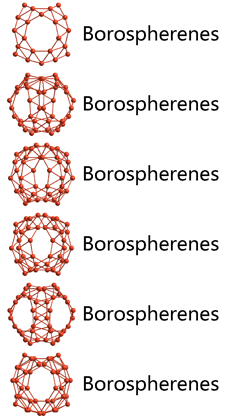
As an electron-deficient element, boron possesses fascinating three-dimensional structures and unconventional chemical bonds. Nanoclusters of boron have also been found to exhibit intriguing structural properties, observed to have predominantly planar structures, in stark contrast to bulk boron allotropes, which are composed of the ubiquitous B12icosahedral building blocks. Here, we report observation of the 2D-to-3D transition and bulk-like structural features in the size-selected boron clusters, as revealed by photoelectron spectroscopy, chemisorption experiments, and first-principles calculations. In the small to medium cluster size range, planar boron cluster anions are found to be unreactive and only B46-and B56-are observed to chemisorb C2H4 and CO under ambient conditions, suggesting major structural transitions at these cluster sizes. Notably, B56- is also found to be able to chemisorb and activate CO2. The global minimum of B46- is found to adopt a core-shell structure (B2@B44-), consisting of a B2 core within a B44 shell, reminiscent of the interstitial B2 dumbbells in the high-pressure γ-B28 form of bulk boron. More remarkably, both the global minimum and the second most stable isomer of B56- exhibit nest-like configurations, featuring the iconic B12 icosahedral core surrounded by a B44 half-shell (B12@h-B44-), signifying the onset of bulk-like structural characteristics in boron nanoclusters.